
Content Agencies = Creative Exploitation
YouTube Confidential: A Decade Under the Influence

As always, I’m Taylor Gunn.
A Writer/Editor/Producer and all-around “YouTube guy” with over 7+ billion views, who's worked with hundreds of YouTube’s top Creators (like MrBeast) over the course of thousands of videos over a decade long, albeit checkered career doing every job imaginable to keep the content machine well fed. In some ways, I’m a professional ghost, not to be seen or heard… until now.
And this… is YouTube Confidential.
You know what, I’m about to say it… I don’t care that you broke your elbow… and also…
I think that if you’re exploiting creative work from other countries based on monetary conversion rates while keeping the lions share of profits for yourself AND preventing said creatives from using said work in their professional reels and portfolios, you’re an evil prick that deserves to be tarred, feathered, and publicly flogged.
Welcome to fucked up world of Creative Agency Exploitation.
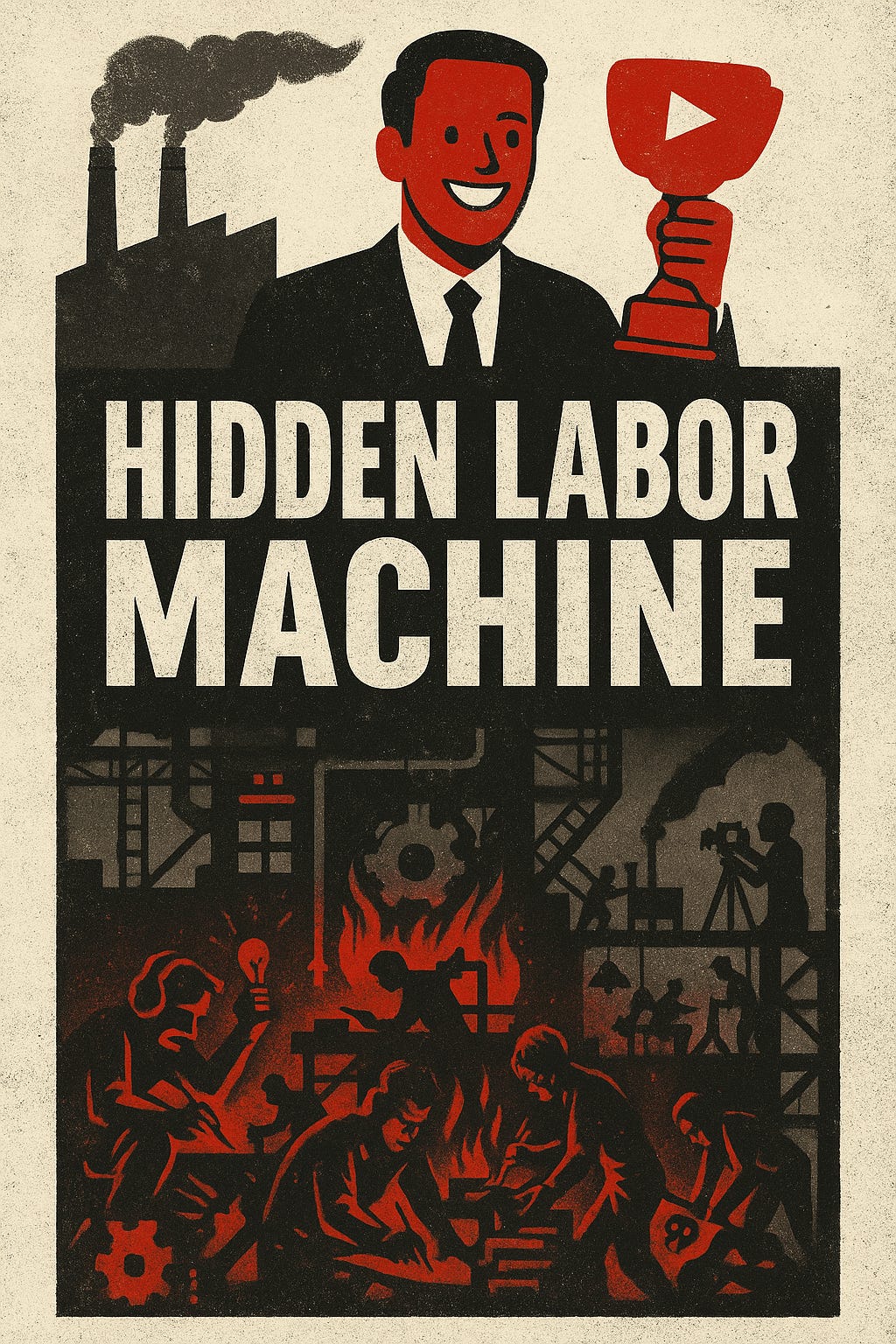
The backbone of any industry is the people at the bottom, and YouTube is no exception.
I’m sorry to say that the bright, happy faces you see on camera — the ones with whitened teeth and an endless supply of reheated enthusiasm — could be switched out for any other bright, happy face with whitened teeth.
This is a statement that is NOT true for very niche topics that require a passionate knowledge such as Age of Sigmar Miniature Painting, or Golf Swing Coaching, but there is a hidden level to YouTube at the top where the person on-screen is hired talent with a media company paying their contract.
Like Michael Stevens from VSauce, the amount of these types of channel may surprise the public who think the person they see is writing, filming, and editing the whole enchilada.
But the truth is, as long as you can read a teleprompter while maintaining the illusion that you're talking TO an audience rather then not reading words someone else wrote, you’ll do just fine.
It might sound hard to those who've never done it, but I promise you, after five videos and some brutal feedback, you'd be a pro.
I explain this to you only to make a singular point…
The real foundation of any content machine isn’t the "talent."
It's the people who work the graveyard shift with cracked screens and caffeine sweats just to hit the deadlines. It’s content strategists, scriptwriters, producers, directors, cinematographers, thumbnail artists, graphic designers, digital imaging techs, editors, visual effects artists, and the poor souls trying to manage the entire chaotic circus who go by many unofficial titles such as managers, supervisors, department heads and the occasional director of whatever.
But oh, the assistants. Let’s not forget the assistants.
In the wild west of YouTube, everyone wears too many hats. Your thumbnail artist might double as graphic designer for your socials. Your sole editor is also probably your VFX artist. Your scriptwriter becomes your ideation manager, and sole researcher, and it’s anyone’s guess who get’s roped into being a social media manager.
The point is… Everyone's hustling, covering gaps, making miracles happen with duct tape and sheer willpower.
But there’s one business model that has wedged itself into the bloodstream of new media like a parasite dressed as a helping hand: Agencies.
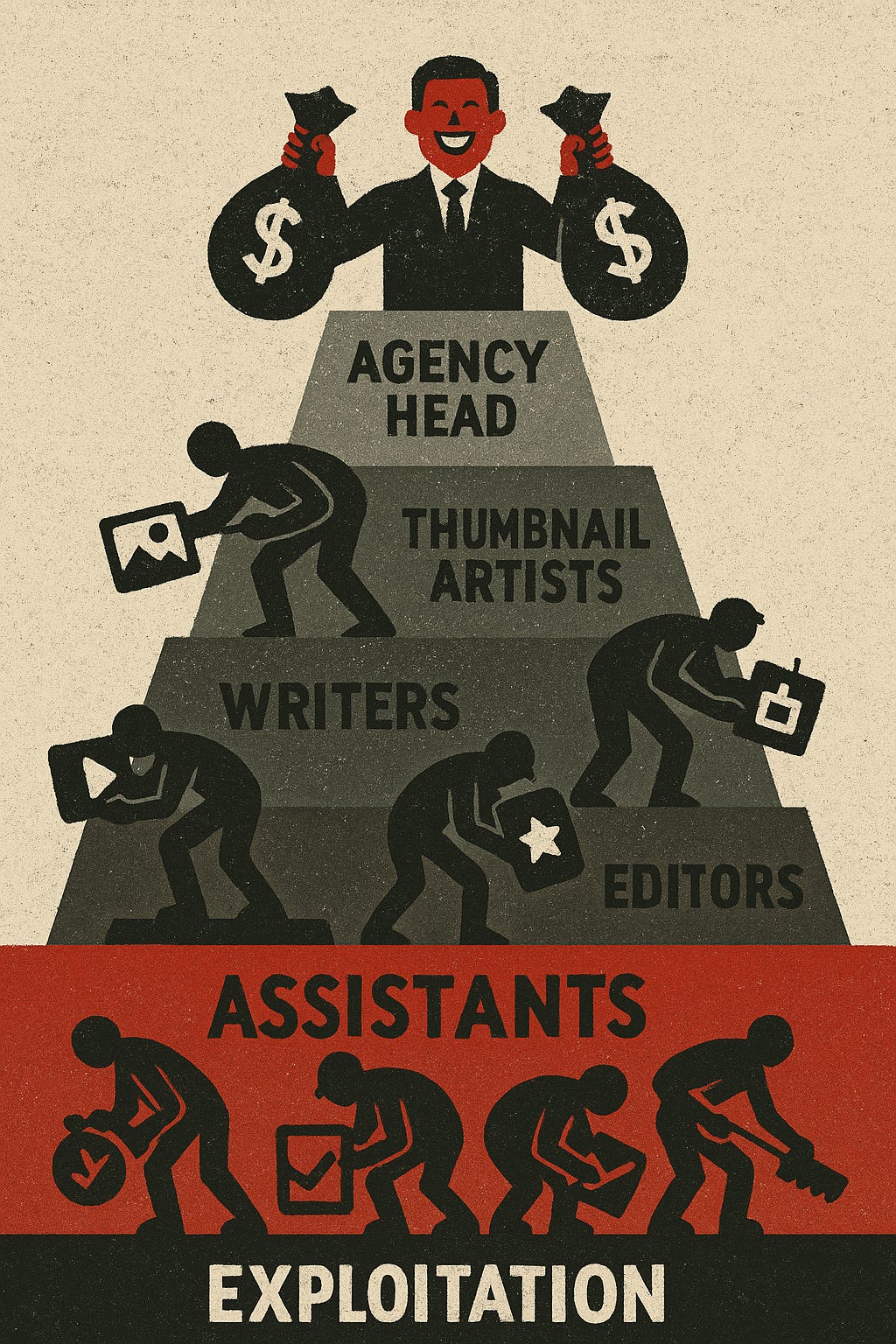
The Rise (and Rot) of the Agency Model
If you’re in the industry, you already know the drill. If you’re not, buckle up.
Agencies are usually a collection of freelancers tied together by a middleman — often a bright, likable "founder" who acts as the face of the operation.
They sell creators on a one-stop-shop solution: "We'll handle your scripts, your edits, your thumbnails, your channel management!" All you have to do is smile into the camera and collect the checks.
In some cases, these Agencies specialize in just one of these formidable tasks, in which case, they have a troupe of underlings at their ready at their say so.
On the surface, it sounds great. And sometimes, it can be. Agencies can be a fantastic way for newcomers to get experience working with bigger names they wouldn’t otherwise touch.
But the problem is what always happens when "business" sniffs the blood of creative labor: exploitation at scale.
Cheaper rates, bigger profits, turn em’ and burn em’ puppy mills.
There are agencies clearing high six figures — hell, some clearing seven — while paying the actual creatives peanuts. I know of one personally where the agency head pockets around 80% of all earnings, leaving a global network of underpaid editors, writers, and artists scrambling for scraps.
I know this because… In my early days, I worked for those shitheads. The allure of working with big names can blind any early freelancer and I was no exception. But the problem exists globally, and that’s where the problem really lies.
Workers from India, Bangladesh, Eastern Europe, Africa — told $100 a week is "good money" while they churn out gold standard content for big name channels. (And I mean BIG NAMES here folks)
But, what if they dare to dream of building a portfolio out of this once-in-a-lifetime opportunity?
Tough shit.
Most agency contracts forbid creatives from claiming credit for their work. If you even hint that you worked for a major creator through the agency, you risk a takedown notice. Your labor, your ideas, your sweat — erased.
"You’re not a creator, or even a creative… You’re a nameless, faceless ghost."

The Hidden Cost: Reputation Risk
YouTubers live and die by trust. A single scandal, a whiff of unethical behavior, and your career can nosedive overnight.
And yet, many creators unknowingly tie their reputations to agencies with no real insight into how those agencies treat their workers, after all… How would they know?
There's a smiling agency founder telling them everything’s peachy. Meanwhile, the people actually making the content are isolated, under NDA, stripped of voice, credit, and often dignity in the form of underpayment and an unsecured livelihood that always feels more then a little at risk from project to project.
It’s a massive liability. And most creators don't even realize the loaded gun pointed at their reputation until it’s too late.
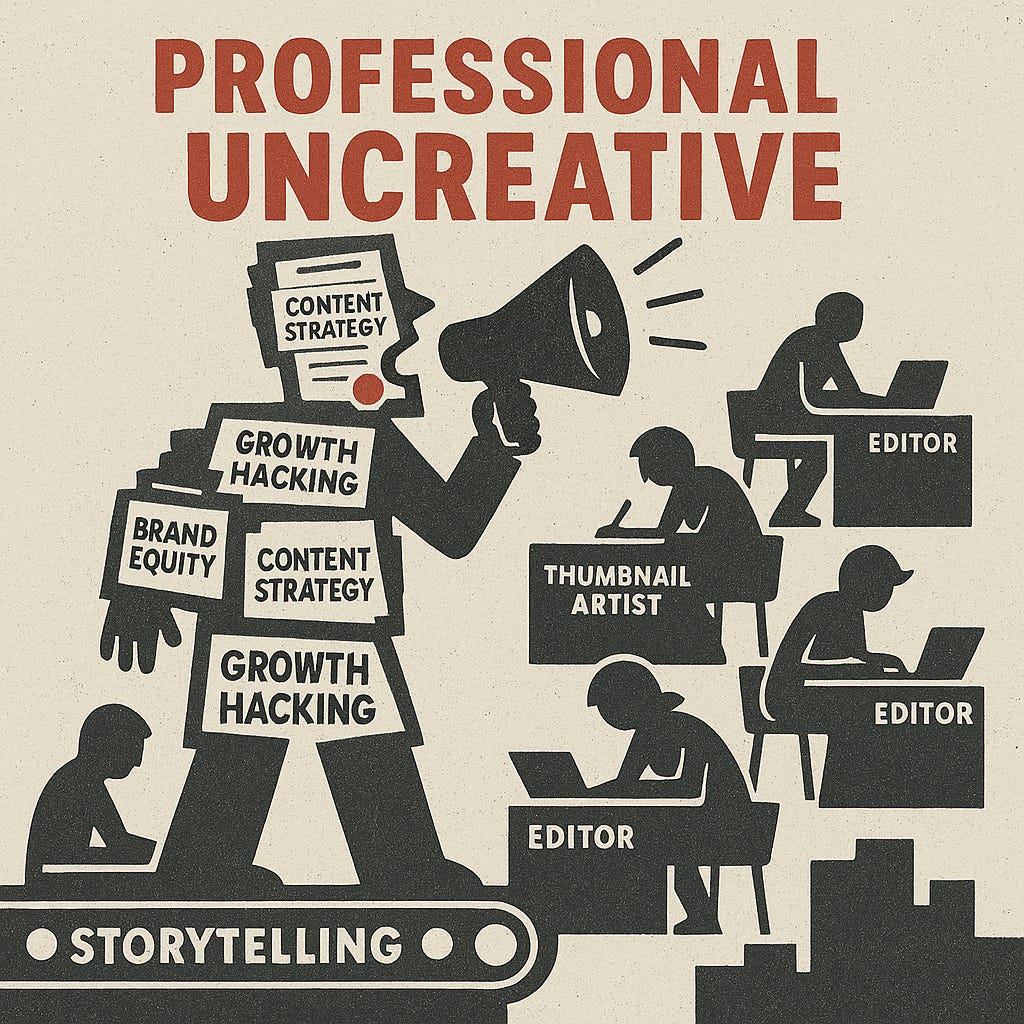
Professional Uncreatives: The Real Parasites
Before we illuminate this situation further, we need to turn the spotlight a bit and discuss another infestation in our midst: the Professional Uncreatives.
These are the people who can't write a script, can't design a thumbnail, can't edit a timeline, can't direct a scene — but who have somehow fashioned entire careers out of "consulting" in this creative industry.
They'll give you lectures on storytelling but couldn't write a short story with a gun pointed at their head.
They'll critique editing without ever having recovered a crashed project file.
They'll regurgitate half-understood theories they lifted from real creators, academic papers, and storytelling handbooks — wrapping it all up in buzzwords like "synergy" and "content cadence." and my favorite, “data-based”
"Professional Uncreatives: the barnacles clinging to a ship they couldn’t build, trying to tell the captain how to steer."
They worm their way into the ear of creators, whispering advice about "cutting costs," "playing it safe," "following proven formulas" — killing creativity one analytics spreadsheet at a time.
These are a breed of people that I truly despise. Not only because they are glorifed uncreative nerds with no souls… but because, client by client, they are turning this platform I love into a circus of unoriginal monetization schemes to hijack the brains of those foolish enough to click.
We’re talking about the true YouTube Dark Arts here folks.
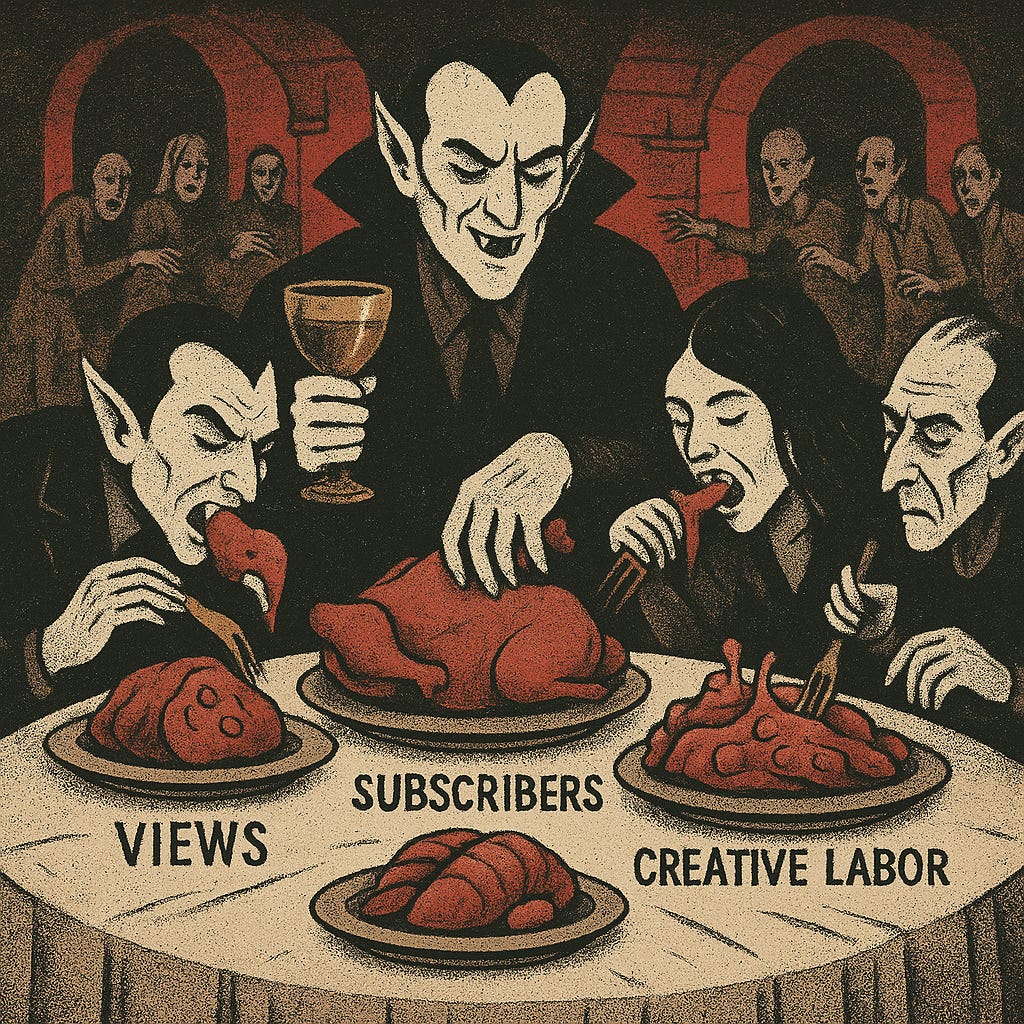
What This Industry Could Be WITHOUT Vampires
I mention these “Professional Uncreatives” because, in my mind, they are firmly fixed beside Toxic Agency Owners in a bucket labeled in big black marker: “Industry Vampires”
Even despite them though, YouTube is still the most beautiful, chaotic, powerful platform for creative expression in human history.
Anyone with an idea and an internet connection can build an audience, launch a movement, change lives.
But I’m writing this article with my particular view from the inside to say we are at a crossroads in media, labor, creativity, and meaning.
If we let agencies and “Professional Uncreatives” dominate the ecosystem, we risk turning this miraculous, messy playground into just another hollow corporate wasteland — where passion is mined, repackaged, and sold until there's nothing real left.
When you remove effort from commitment, you remove the depth of that commitment. When you remove the depth of a commitment, you remove its meaning. When you remove its meaning, there’s nothing left.
It’s the depth — the hard, messy, brilliant depth — that gives YouTube its soul.
And we’re already watching that soul get siphoned away, one underpaid editor, one silenced assistant, one corporate "best practice" memo at a time.
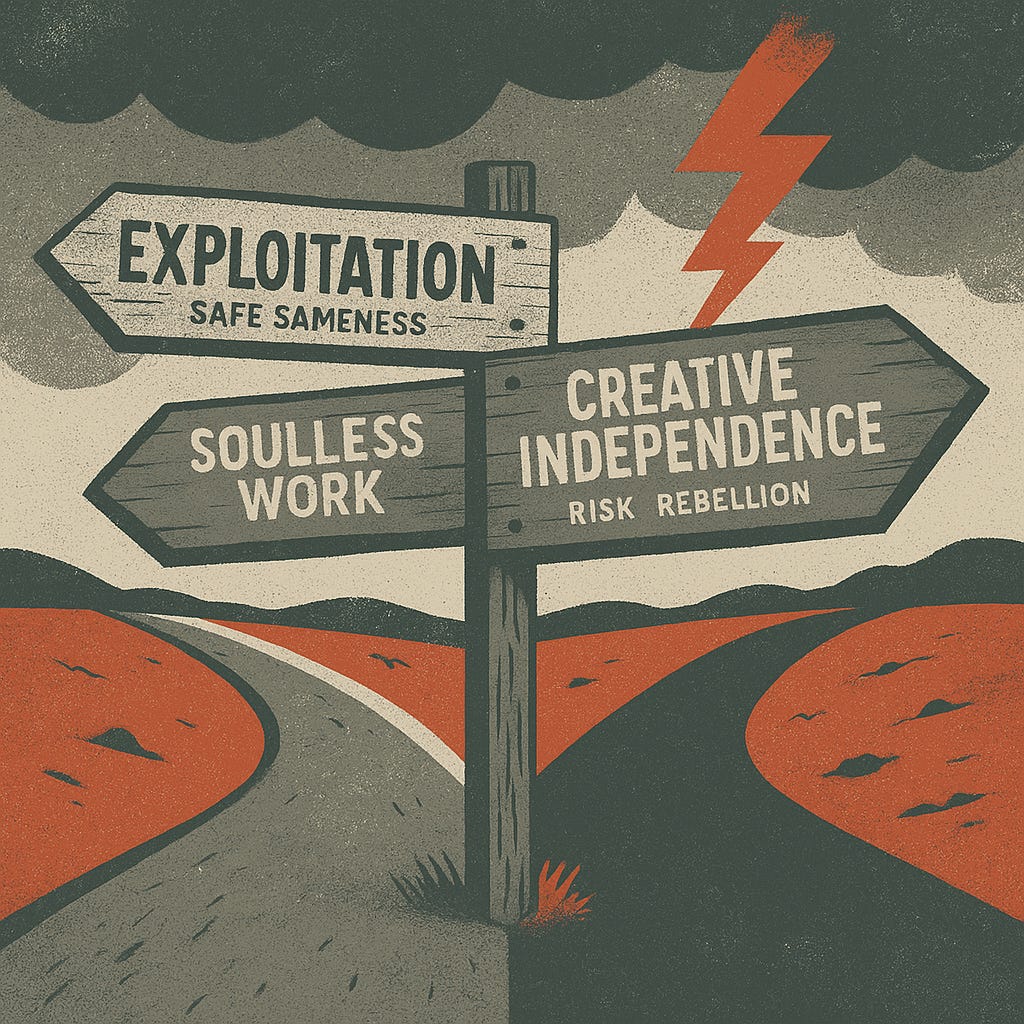
Spot the Parasites, Starve the Host
So… how do you spot these agency vampires before they drain you dry?
Here’s a starter pack:
No Portfolio Policy = Red Flag – If the agency forbids you from showing your work publicly after it goes live, that's not professionalism. That’s control. Creatives deserve receipts. Demand credit, always. Your future relies on it.
(There’s one caveat to this… some creators VALUE exclusivity and privacy, and as such, they tend to pay highly competitive rates… if you’re getting paid for your silence, do what I do, and gladly shut the fuck up.)
Founder’s Face Everywhere but not the Team's? – If the website and socials are all "Look at me, I’m a thought leader!" and there’s no transparency about the actual editors, writers, or artists behind the scenes, RUN. That’s a cult of personality, not a team, and there’s probably a reason they aren’t publically tieing themselves to the people working for them.
One Flat Rate Fits All – If you’re being paid the same $100 per video regardless of length, complexity, or scope… GTFO. Agencies with one-size-fits-all pricing aren’t managing a team, they’re farming labor.
(Of course, the expection to this is if your flat rate is a good rate. $100, $200, $300… these are not good rates)
NDAs with No End Date – Burn those bastards. Literally or metaphorically. Once a video is public, it’s fair game. Use it in your reel. Talk about it. Credit yourself. They’ll huff and puff and send scary emails — ignore them. They’re paper tigers.
(It should go without saying, but this is not legal advice) 😂
If you’re still scared of backlash, Here’s how you torch them while staying technically "compliant."
Add a credit to your work that says:
“Post-production by [Your Name] in association with [Agency Name] for [Client Name]”
This gives you plausible deniability and search engine juice.
If you're trapped inside one of these parasitic outfits, join my discord where I’m always posting job openings. If your reels good and you’re good, I’ll help you find better.
(Discord Link at The Bottom)
And Listen up… If you’re a Creator working with an agency like this…
You need to vet your vendors. Talk to the editors. Ask how they’re treated. If they’re not allowed to talk to you? There’s your answer. At the VERY LEAST there needs to be an “open-air” group chat that a representative of the creator can see happening within the agency.
At the end of the day, Say it loud: “I made this.”
Put it on your site, your reel, your bio. Credit the agency if that makes you feel better, but don’t let them relegate you to ghost… it’ll do NOTHING for your career. Trust me. I know.
Protect your reputation at all costs, before the vampires drain it dry.
If I’m placing my bet, that’s where my money is.

WHAT IS YOUTUBE CONFIDENTIAL?
IN MANY WAYS, YouTube Confidential is a love letter to YouTube, the industry that gave a wretch like me more than I ever deserved or thought possible. In other ways, it’s a road map of scars, burnt bridges, and ego-deaths outlining my checkered career – that at times, is far more honest then I’d ever wished to put down on paper.
My justification for said honesty is that I truly believe that in doing so, I’ll help others avoid my mistakes and avoid years of wastrel and wayward behavior and get to where they want to be faster. That means more money, less bullshit, and doing meaningful, fulfilling creative work without all the drama and stress that is all too common in our industry.
For the common reader, I hope "YouTube Confidential" is good for a few laughs while exposing the creative malpractice that takes place daily in the industry’s labor ecosystem.
The editors, strategists, and thumbnail artists I work with and talk to on a daily basis are the lifeblood of this industry, and I hope to shine a spotlight on those dark, damp and downright abused corners in this place we all call home.
SOCIALS:
If this hits close to home for you, please reach out to me like I said. I want to help people avoid working for places like this.